Showing posts with label Digital History. Show all posts

Wednesday, May 6, 2026

Students present Original Research


History students Kayla Krupski, Ava Dimao, Morgan Kilger, and Isabella Biviano, presented their work at the Student Research and Creativity Exposition. They created posters based on work they had done in history classes, including ways to use AI in research. Students in History 419: Digital History and Archival Practices researched a book from St. Bonaventure's Rare Books and Special Collections using old-fashion archival research combined with AI tools such as NotebookLM from Google.


Wednesday, February 28, 2024

History Class works with Eldred World War II Museum


Eldred World War II Museum

Students in History 419: Digital History and Archival Practices are starting new projects working with the Eldred World War II Museum located in Eldred, PA. Over the next few weeks, they will be working with museum staff to build a digital complement for an exhibit in the museum. Stay tuned as we work on these cool projects.


Friday, March 11, 2022

Remote Internship at Idaho State Archives

This if from the Idaho State Historial Society's News Letter, on the same page. Thomas Chaddock is doing a remote intership using TheirStory. Thomas played a big role in the archiving the pandemic at SBU project. 

Thomas Chaddock | Intern, Idaho State Archives My name is Thomas Chaddock and I am a junior at St. Bonaventure University in Allegany, New York. I currently work alongside HannaLore as an oral history intern. Even though I have only been an intern for a short time, I have already gained valuable insight into the work of historians, archivists, and the agency. By using the professional skills I gained from HannaLore, I have deepened my critical thinking skills to produce impactful public-facing history. I appreciate this experience and look forward to making a positive contribution at the ISHS.

Wednesday, October 27, 2021

AR/VR - the future of history?

This week Dr. Gabriel Swarts meet with students in History 419: Digital History and Archival practices to talk about the changing field of history and the role that augmented reality and virtual realy will play in it. Then the students got to break out some VR headsets to play.
 

Tuesday, September 14, 2021

Oral History project on St. Bonaventure and Pandemic using TheirStory


In History 419: Digital History and Archival Practices students are doing an oral history project using TheirStory. TheirStory is an exciting company founded by Zack Ellis in Rochester, NY. TheirStory allows students to conduct interviews, create transcripts with tags, and present them on the Aviary Platform

Friday, April 23, 2021

Archiving the Pandemic Experience at St. Bonaventure University

 The St. Bonaventure University Archives is pleased to announce the launch of their new website St. Bonaventure during COVID-19. The project was created by archival interns Josie Barcley, Thomas Chaddock, Alex Jodush, Kurt Stitzel, and Jackson West.

The site offers users insight into what life has been like for students, faculty, and staff during the COVID-19 Pandemic. It provides an opportunity to learn about the numerous challenges present on and off campus, looking at changes in the classrooms, at various dining facilities, and in the residence halls.

The website includes the recollections of members of the Bona community relating their thoughts about and experiences during the pandemic. It also includes graphs, charts, and images as further evidence describing this unusual time.

The project is still active and we encourage members of the St. Bonaventure community to participate by filling out the survey available on the home page of the site. Your answers are completely voluntary and made anonymous once posted to the site. You can share with us as much or little information as possible.

If you would like to learn more about this project, or wish to share your pandemic experience, please contact us @pandemic2020[pa1] .

Saturday, March 6, 2021

History 419: Digital History and Archival Practices

 Phillip Payne and Dennis Frank are offering History 419: Digital History and Archival Practices next fall. If you like getting your hands dirty doing original archival work on the history of St. Bonaventure University, creating any number of cool digital products this is the class for you. We've made podcasts, maps, web pages and much more in the past.

Wednesday, April 22, 2020

Documenting the Pandemic at SBU Update

Homemade Face Mask with Instructions

We now have a Google Doc explaining three ways you can share your experience with the archives, and thus the future.  (1) You can email the document to pandemic2020@sbu.edu.  You can do it as a Google Doc (which it is), download it as a MS Word doc, or cut and past it into MS Word.  (2) You can complete this Google Form.  If you want to send us audio, video or pictures use WeTransfer to send them to pandemic2020@sbu.edu.  WeTransfer is easy to use.  Just enter your email, the destination email of pandemic2020@sbu.edu, select the file and let it send the file.  It works on most devices.

If you work or study at St. Bonaventure University, we hope you take a few minutes to reflect and document this experience.

Wednesday, April 15, 2020

Documenting the Pandemic at St. Bonaventure University


Josie, Alex, and Kurt in History 419 (Computer Lab in Friedsam Memorial Library)

Josie Barcley, Alex Jodush, and Kurt Stitzel (pictured above in History 419:  Digital History and Archival Practices) have set out to capture at least some of the Bonas experience during the pandemic.  Growing out of a discussion with University Archivist Dennis Frank that there are very few records from the 1918 pandemic at St. Bonaventure University, the three students proposed that they set up a system and start collecting documents and reflections on what the 2020 pandemic has meant for the SBU community. 

This is a work in progress, but the Josie, Alex, and Kurt are reaching out to students and others to ask them to share their materials.  You can learn more on the archives web site or you can contact the team at pandemic2020@sbu.edu


Monday, April 23, 2018

Digital History Class Winds Down


We're winding down Digital History and Archival Practices.  We're pulling together our projects for the Arts & Sciences Exposition 2018, where we will display the nearly finished map of the St. Bonaventure Cemetery and unveil the apps and the wiki we have been working on.  We started the semester with no experience in app design and now we have functioning apps.  the apps are in beta, so more work to be done, but we're excited to see what people have to say.

Saturday, April 7, 2018

Legacy Assignment: We're almost done with the SBU Cemetery Project

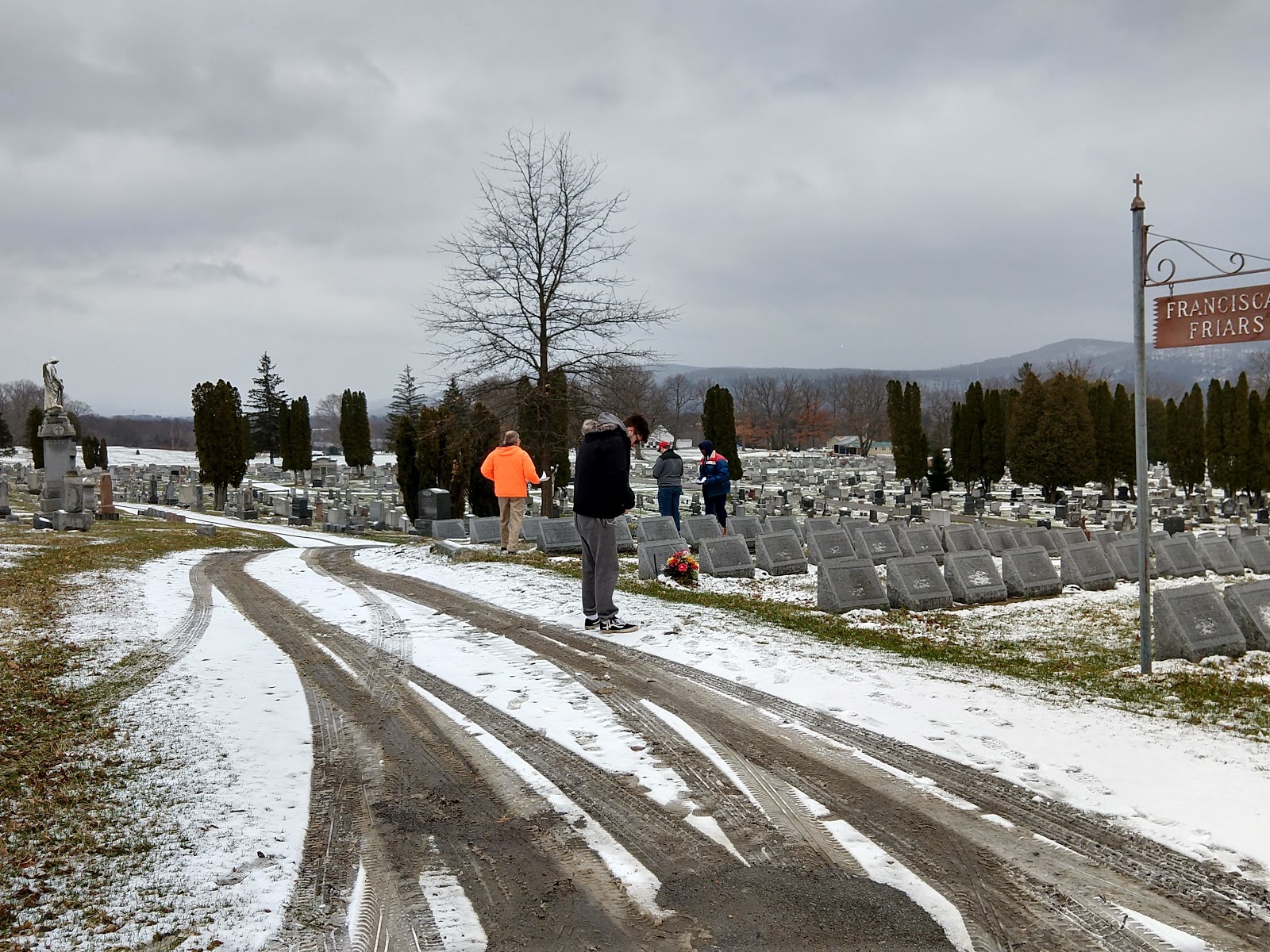
Spring in Western New York has not been kind.  In the digital history and archives class we've been waiting for a break to get to the cemetery.  Starting in 2014, students in each version of the class has contributed to our ongoing project to build a digital map of the cemetery creating a "living obituary" with a digital map.  We're nearing the end of the project. 

 A great deal of the work is done in the computer lab and in the archives, but we do need to spend some time in the field collecting coordinates and pictures.
 It hasn't been a good stretch for walking around the cemetery.  Still, we finally decided to go for it.  It was cold, but not terribly cold, and the rain/wintery mix held off for the hour we were there.

Friday, February 23, 2018

Digital History and Archival Practices at work


We're exploring apps and mobile technology in History 419:  Digital History and Archival Practices.  Students hard at work building a prototype app.


Friday, January 19, 2018

Carter Bunce's Project on Prohibition


Carter Bunce made a fine web page about Prohibition for History 407:  Twentieth Century United States History.  Check it out.

Wednesday, November 1, 2017

History Offerings


Registering for Spring 2017 courses is just around the corner.  With that in mind, the history department is offering some interesting courses including two new special topics courses.  Chris Dalton is teaching the Way of the Warrior in China and Japan.  Steven Pitt is teaching Piracy in the Americas and the American Revolution.  The piracy course is a new offering and the American Revolution is always timely.  Phillip Payne is offering a course the senior reading seminar on the United States Presidency and, with Dennis Frank, Digital History and Archival Practices.  If you want to learn about how historians practice and adapt to the information revolution, this is the class.

Monday, May 15, 2017

Connecting the dots between liberal arts and careers

It may be to the outsider that some of the things on appearing on the blog don't add up - what's up with a history department and GIS, THATCamp, Escape Rooms, Game Design, and other stuff.  Yes, we still teach history. Students read books and write papers.  That's not going away.  In fact, the bulk of what we do falls into those categories.  The ability to deeply read a text, write a clear paper, and use content knowledge to place events in context has never been more important.

However, we're also adding some spice to how things have been done in a history class.  Some of it, frankly, is experimentation with the goal of having fun.  Why not?  Fun is a powerful thing when it comes to learning.

 But as you can tell from other postings, we're giving serious thought to the relationship between the liberal arts and careers.  For starters, reading, writing, and content are important for life and work, but we also live in an age when things are changing rapidly and much of that change is driven by technology and data.  For those of you who graduated pre-internet, think about how much our work, entertainment, and lives have changed.  Frankly, there are now many careers that didn't exist 20 years ago and who knows what will exist 20 years from now.

There is a lot being written about this topic.  We're urged to "adapt and survive" and to "race with the machine."

Fair enough.  How?

This brings us back to the innovations we've been introducing to history classes.  There is one word you need on your resume today, and that is digital and so you see our work in digital history.  This is why we're working in GIS, website creation, podcast, and such.  Students should have digital on their resumes in a concrete and professional way.

We're also giving some serious thought to how design fits into this - hence the game design and gamification.

We've been working with Bill Bechdel of XPhobia and Jennifer Pulver of SBU's events office to create an escape room summer camp.  Don't know what an escape room is?  Check out the Olean Times Herald story on Bill's room.  According to Bill, “It’s like stepping into a movie — you’re a part of the action,” he said. “My idea is to bring as much immersion to this as possible.”  For participants, it is an authentic, immersive experience.  

For educators, it's a chance to blend content with design in the curriculum.  It's a chance for educators and students alike to learn.  The next step is to take the ideas we develop with the escape room camp and bring them into classes.  That, it seems, is the key to adapting - and having fun.

Thursday, April 27, 2017

Careers and the History Major


Paul Sturtevant's article for the American Historical Association, "History is Not a Useless Major:  Fighting Myths with Data," offers up some data from the American Community Survey on the fate of history majors as they pursue careers.  We've long known that most history majors don't go on to become professional historians, but that doesn't mean they don't pursue careers.

Check out one of my favorite points from the article, screenshot ⇩ Turns out history majors get jobs.

However, we're not oblivious to the concerns who fear that studying history.  We're incorporating digital and design projects into our classes, especially the digital and public history classes, to help students learn 21st-century skills and articulate the skills and knowledge they develop in our classes.

Turns out nearly half of history majors go on to graduate school ⟱ and many go on to work in education, law, and business.


Tuesday, February 7, 2017

Liberal Arts and Jobs...


This piece, "Liberal Arts Majors Have Plenty of Job Prospects, if They have some Specific Skills, Too," in the Chronicle of Higher Education points out the value of a liberal arts education when combined with managerial and technical skills.  This is certainly a message we've been preaching in the digital and public history courses.

From the article:

"Employers really value soft skills that are the bedrock of a liberal-arts education," he says. But many employers are also looking for applicants with additional, specific skills, such as knowledge of Java or other programming languages, or proficiency with graphic-design tools like InDesign or Adobe Creative Cloud. "It’s not a matter of shutting down the classics department and turning it into a business degree," he says.
...
The company identified skills in eight fields, and then found an additional 863,000 entry-level jobs for graduates with skills in one or more of those fields. For example, the analysis found an additional 137,000 entry-level jobs for liberal-arts graduates who had data-analysis or management skills. It also found that such data-analysis jobs paid an average of $12,700 above the average salary for jobs traditionally open to liberal-arts graduates without such skills.

Monday, October 10, 2016

The Future of History


In the spirit of our upcoming THATCamp, check out this TEDx talk on the Future of History.

Wednesday, July 20, 2016

Teaching Bonas History


There is a nice article in today's Chronicle, Why a College Should Teach Its Own History, that is worth reading.  We don't teach a class on St. Bonaventure's history, but students in students who take public history, digital history and history internship often spend a lot of time working in our archives telling the history of Bonas.  It's a great way to learn something about their school, do original research, and learn some of the skills of public and digital history.

Friday, May 13, 2016

Arts and Sciences Expo


History Majors were again well represented at the Arts and Sciences Student Research and Creative Endeavors Exposition, a great event featuring some great work by our students.  You can check out pictures (better than my humble pics) on SBU's Flicker account where you will see history majors showing off their work in the digital and public history classes.

The games from the public history class were available for inspections - and play!  Below is a poster explaining the connection between the games and the Civil War research.


Our digital map of the cemetery, part II, as Carter Bunce (pictured below) and other students showed off our continuing development of that project.